Mini golf hole ideas are easiest to use when each hole has one clear challenge: a tunnel, a ramp, a bank shot, a curve, a target, or a simple obstacle that players understand before they putt. For a party, office event, school activity, backyard course, or fundraiser, you do not need 18 complicated holes. You need a few safe lanes, simple materials, and rules that keep the group moving.
For context on how garden putting, artificial surfaces, and themed obstacles developed, read the history of mini golf.
This guide focuses on temporary mini golf holes you can build, rent, or set up for an event. If renting is the better fit, use the mini golf rental guide to compare portable course sizes, space, setup, and vendor questions. If you are designing a permanent commercial course, use the mini golf course design guide and mini golf course ideas guide instead.
Quick answer: mini golf hole ideas that work
The best mini golf hole ideas for parties and offices are simple enough to build quickly but varied enough that each hole feels different. Start with 3 to 6 holes for a small event, use groups of 2 to 4 players, and set a 5 or 6 stroke limit per hole.
Use this starter set:
| Hole idea | Best setting | Main challenge |
|---|---|---|
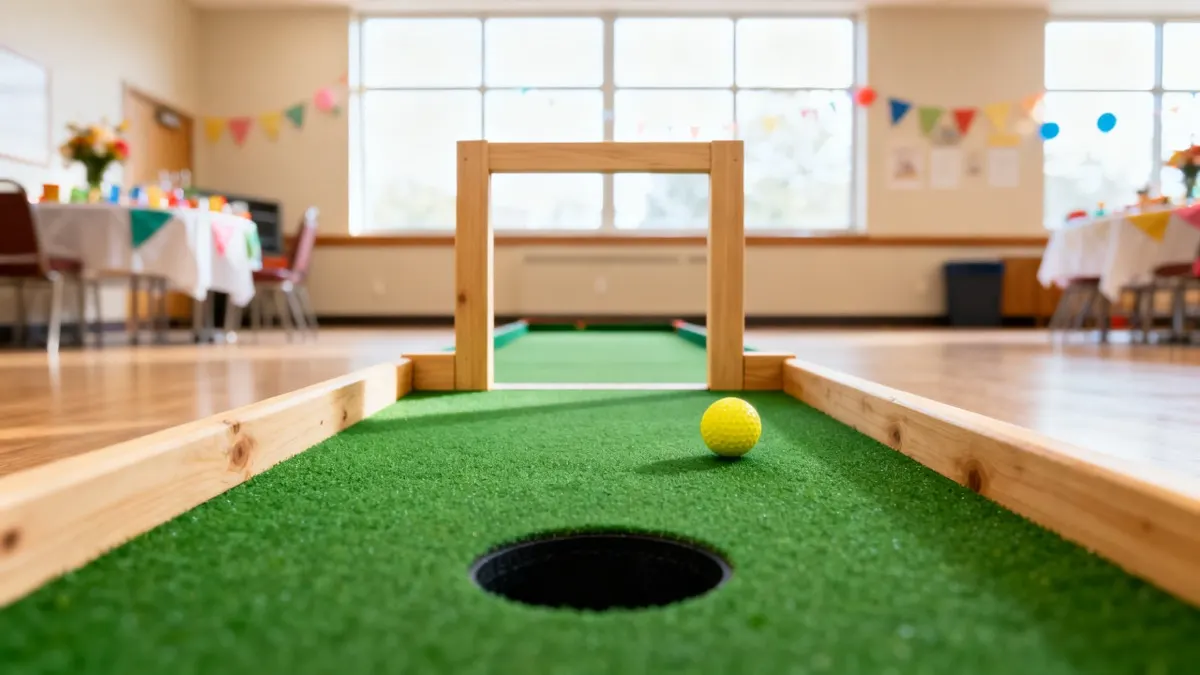
| Straight gate | Offices, classrooms, kids parties | Putt through a small opening |
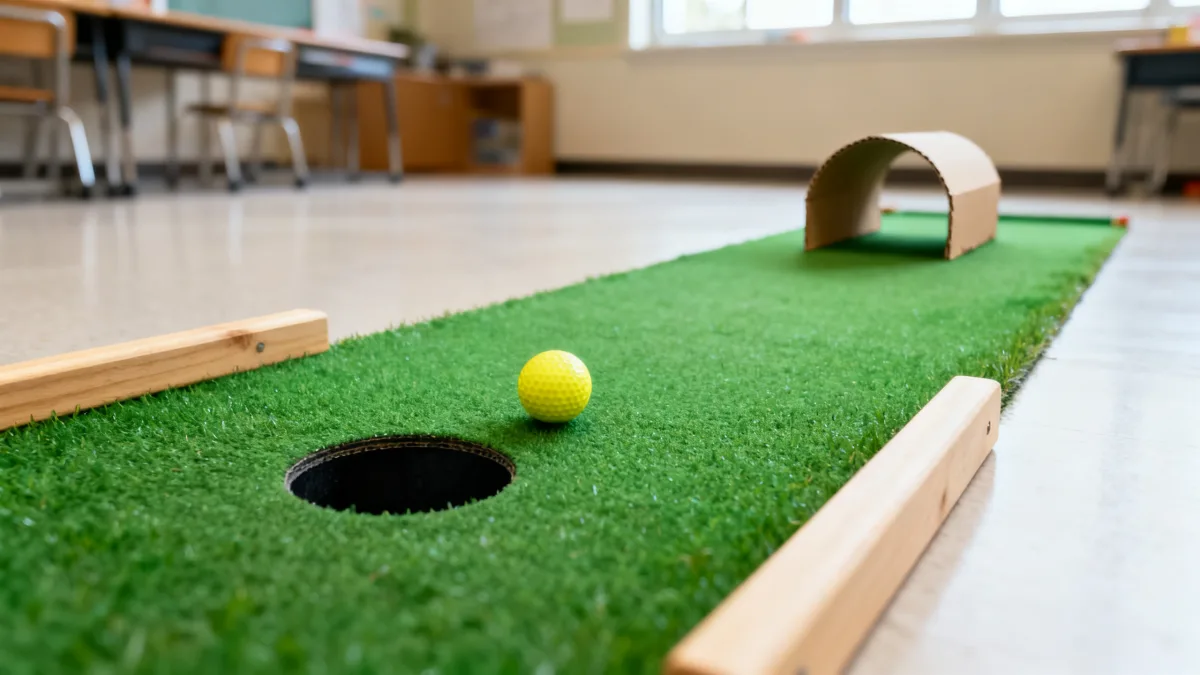
| Box tunnel | Backyard, school, birthday party | Aim through a cardboard tunnel |
| Pool noodle curve | Backyard, gym, hallway | Follow a safe curved lane |
| Small ramp | Older kids, teens, adults | Control speed up a gentle rise |
| Bridge shot | Parties and school events | Cross a raised or decorated path |
| Slalom path | Office or backyard | Weave between cones or cups |
| Target circle | Small rooms and young kids | Stop inside a marked zone |
| Split path | Adults and team events | Choose a safe route or risky route |
| Mystery wall | Work events and fundraisers | Bank the ball around a hidden angle |
Start with the format, not the obstacle
Before buying supplies, decide how the mini golf setup will be used. A 4-year-old birthday, an office hallway course, a fundraiser, and a backyard cookout need different holes.
| Format | Good number of holes | Best lane length | What matters most |
|---|---|---|---|
| Kids birthday | 3 to 6 | 6 to 10 feet | Wide paths and quick turns |
| Office mini golf | 3 to 9 | 8 to 15 feet | Floor protection and traffic flow |
| School or camp activity | 6 to 9 | 8 to 12 feet | Supervision and clear stations |
| Backyard party | 3 to 6 | 8 to 20 feet | Weather-safe materials |
| Fundraiser | 9 or more | Varies by space | Sponsor signs and scoring |
| Team building | 6 to 9 | 8 to 15 feet | Team roles and fair difficulty |
For a normal party, 3 to 6 holes is usually enough. Guests can replay the course, switch teams, or add a bonus challenge from the mini golf games guide. For bigger groups, use the mini golf tournament ideas guide before you promise a bracket or leaderboard.
If you are hosting at an actual course instead of building temporary holes, start with the mini golf course directory, mini golf by location, or mini golf birthday party venues.
Easy mini golf hole ideas for parties
Party holes should be visible, forgiving, and fast to reset. Keep fragile decorations away from the ball path, and avoid obstacles that require players to hit hard.
Straight gate hole
Set two blocks, cones, cups, or small boxes about 8 to 16 inches apart. The player putts through the gate toward a cup, target circle, or taped finish line.
Make it easier by widening the gate. Make it harder by moving the gate closer to the starting line, adding a second gate, or placing the target slightly off-center.
Use it for:
- Young kids who need a clear goal.
- Office courses where the floor must stay clean.
- Warm-up holes before harder stations.
- Closest-first-putt games.
Box tunnel hole
Cut both ends off a cardboard box so the ball can roll through. Tape the box to the floor or weigh it down so it does not move after every shot.
For kids, use a large opening and a short putt. For adults, angle the tunnel so players need a gentle bank shot first. Decorate the outside only. Do not add dangling parts inside the tunnel because they can trap balls and slow the line.
Pool noodle curve
Pool noodles make safe bumpers for backyard, gym, classroom, and party setups. Curve two noodles into a lane, hold them with stakes outside, tape indoors where the surface allows it, or place heavier objects along the outside edge.
Use a wide curve for young kids. Use a tighter curve for teens and adults. The goal is a smooth pace challenge, not a full-strength swing.
Small ramp hole
Use a low plywood ramp, foam wedge, cardboard ramp, or sturdy plastic play ramp. Keep the ramp shallow enough that a normal putt can climb it.
Put a target zone after the ramp instead of a tiny hole. That makes the station easier to run because players do not need five attempts to finish.
Good ramp rules:
- Only one ball on the ramp at a time.
- No full swings.
- Put a soft stop behind the target.
- Skip ramps on slippery floors.
Bridge shot
A bridge hole can be as simple as two low side rails and a flat strip down the middle. For a party, the bridge does not need to be high. A slightly raised strip, a cardboard "river," or a decorated path is enough.
Use this when you want a photo-friendly hole without building a complicated obstacle. If the bridge is raised, test it with the youngest player first.
Slalom path
Place cones, plastic cups, blocks, or foam shapes in a zigzag path. Players putt around them toward the finish.
For younger kids, make the gaps wide and count any ball that reaches the final zone. For adults, score one bonus point if the ball reaches the finish without touching an obstacle.
Target circle
Tape a circle, use a hula hoop, draw a chalk ring, or place a flat mat on the ground. Instead of putting into a small hole, players try to stop the ball inside the target.
Target circles work well indoors because you do not need to cut a hole, dig into the lawn, or use a cup that sticks up from the floor. They also work for accessibility because players can succeed with a controlled putt instead of a precise final tap-in.
Split path hole
Create two routes to the target: a wide safe path and a narrow shortcut. The safe path should always work. The shortcut can save a stroke, earn a bonus point, or simply look more exciting.
This is one of the best adult party hole ideas because it creates decisions without adding much setup. It also works for team events where players can talk strategy before putting.
Office mini golf hole ideas
Office mini golf works best when the holes respect the workspace. Avoid anything that blocks exits, damages floors, creates trip hazards, or makes people hit toward glass, monitors, or open stairwells.
Good office mini golf hole ideas:
| Office space | Hole idea | Setup note |
|---|---|---|
| Conference room | Box tunnel to target circle | Move chairs to the wall first |
| Hallway | Cone slalom | Keep one side open for walking |
| Copy room | Straight gate | Use tape only where allowed |
| Break room | Cup-and-wall bank shot | Keep food and cords away |
| Lobby | Sponsor hole | Use a short lane and clear signage |
| Open office | Desk-leg bank shot | Use only sturdy furniture edges |
| Team area | Department obstacle | Let each team design one station |
For a work event, assign each team one hole to build. Give every team the same limits: one lane, one obstacle, one target, and one safety check. That keeps the course from turning into a contest over who can bring the most supplies.
Use work-friendly scoring:
- One point for finishing under the stroke limit.
- One point for the best team name.
- One point for the most practical hole.
- One point for the cleanest setup.
- One point for the best bank shot.
If the event is mainly about team building, pair this with the mini golf team building guide. If you need larger booking logistics, use the mini golf group event planning guide.
Backyard and school mini golf hole ideas
Backyards, gyms, cafeterias, libraries, and school hallways give you more room than an office, but supervision matters more. Keep holes short enough that players can see the full path from the start.
Backyard lane with bricks or boards
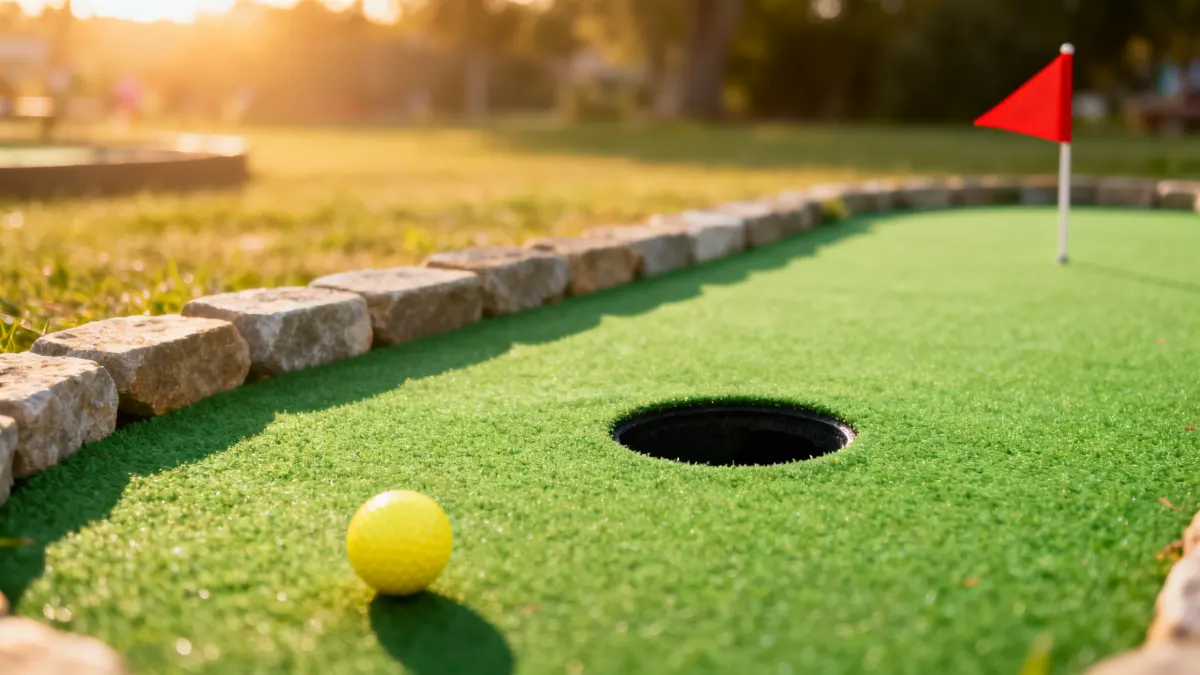
Use bricks, boards, pool noodles, or rubber garden edging to create a lane. If the setup is temporary, place materials on top of the grass instead of digging.
For a more durable backyard build, Jaime Costiglio shows a mini putt platform using artificial turf, a PVC cap for the cup, pressure-treated lumber, and exterior-rated hardware. That is useful for a reusable yard project, but too much work for a one-day party. Scout Life also shows simple backyard layouts using found materials such as bricks, boards, and cinderblocks.
Cardboard castle hole
Use a large box as a castle, barn, tunnel, spaceship, or clubhouse. Cut one wide entrance and one wide exit. Tape the bottom edges flat so the ball does not catch.
This is good for school events because students can decorate the outside before the round. Keep the playing path plain so the hole still works.
Hula hoop island
Place a hula hoop on the floor or grass. The ball must stop inside the hoop. For older players, put a smaller target inside the hoop for a bonus point.
This is a strong station for younger kids because it rewards distance control without forcing a final tap-in.
Bucket tunnel
Turn a small bucket, beach pail, or plastic container on its side and cut a safe opening if needed. The player putts through the bucket to reach the target.
Use lightweight containers only if they can be secured. A bucket that moves after every shot becomes frustrating for the next group.
Sponsor sign bank shot
For fundraisers, make a safe sign or foam board the bank-shot wall. The sponsor gets visibility, and the hole gets a clear challenge.
Keep sponsor signs outside the walking path and avoid sharp stands. If the event is raising money, use the mini golf fundraiser guide before you set ticket prices, sponsor levels, or raffle rules.
STEM slope hole
Use a gentle ramp, cardboard wedge, or books under a mat to create a slope. Ask players to predict whether the ball will curve, slow down, or roll back.
This works for schools, camps, and field trips because the hole can support lessons on force, friction, angles, and measurement. For a full classroom version, use the classroom STEM lesson plan. For a larger youth outing, use the mini golf field trip guide.
How to design fair temporary holes
A good temporary mini golf hole is easy to understand, safe to play, and quick to reset. The best test is simple: a beginner should know where to aim in under 10 seconds.
Use these design rules:
| Design choice | Good starting point | Why it helps |
|---|---|---|
| Lane length | 6 to 12 feet indoors, longer outdoors | Keeps setup manageable |
| Lane width | 2 to 3 feet | Gives beginners room |
| Obstacles | 1 main obstacle per hole | Prevents slow backups |
| Stroke limit | 5 or 6 strokes | Keeps groups moving |
| Target | Cup, circle, mat, or finish line | Lets you adapt to the surface |
| Group size | 2 to 4 players | Reduces waiting |
| Reset time | Under 30 seconds | Keeps the course flowing |
For kids, make the first hole easy. A quick early success helps the group settle in. For adults, add challenge with route choice, not tiny targets. A narrow shortcut is more fun than a hole that needs repeated retries.
If you plan to keep the course up for more than one day, think about durability, drainage, supervision, and cleanup. The how to build a mini golf course guide covers bigger planning questions for permanent or semi-permanent setups.
Materials and setup checklist
You can build temporary mini golf holes with basic household, classroom, or office supplies. The best materials are light, visible, and easy to move.
| Material | Use it for | Watch for |
|---|---|---|
| Painter tape | Start lines, target circles, boundaries | Test on the floor first |
| Cardboard boxes | Tunnels, castles, walls | Tape edges flat |
| Pool noodles | Bumpers and curves | Secure them so they do not roll |
| Plastic cups | Gates, cones, targets | Avoid crushable cups for banks |
| Cones | Slalom paths and start markers | Leave walking space |
| Hula hoops | Target circles | Tape or weigh down indoors |
| PVC pipe | Gates, rails, light frames | Cover rough edges |
| Plywood | Ramps and lanes | Sand sharp corners |
| Turf mats | Putting surface | Tape edges to avoid trips |
| Buckets | Tunnels and targets | Secure before play |
Before guests arrive, run one full test round with the same ball and putter people will use. Fix anything that makes the ball jump, stop suddenly, roll into a hazard, or leave the station.
Safety checks before anyone plays
Temporary mini golf is low pressure, but bad setup can still create problems. Do the safety pass before guests arrive, not after the first child trips over a rail.
Check these details:
- Balls cannot roll into stairs, parking areas, streets, kitchens, or glass.
- Players have enough space to stand without blocking another hole.
- Ramps do not slide.
- Tape edges do not peel up.
- No cords cross the lane.
- Obstacles are visible from the tee.
- Adults can see younger kids from one spot.
- Players do not need to swing hard.
- Every hole has a clear finish.
- Cleanup supplies are nearby.
For guests with mobility, sensory, or lighting needs, use the mini golf accessibility guide before deciding on narrow paths, glow lighting, loud music, or raised obstacles.
Rules for party and office courses
Rules should fit on one card or one phone note. Long rule sheets slow down temporary courses.
Use this simple rule set:
- Everyone takes a first putt before anyone takes a second putt.
- Count every hit as one stroke.
- Use a 5 or 6 stroke limit per hole.
- If the ball leaves the lane, place it back where it left with one extra stroke.
- Write scores away from the active hole.
- Venue, school, office, or house rules always win.
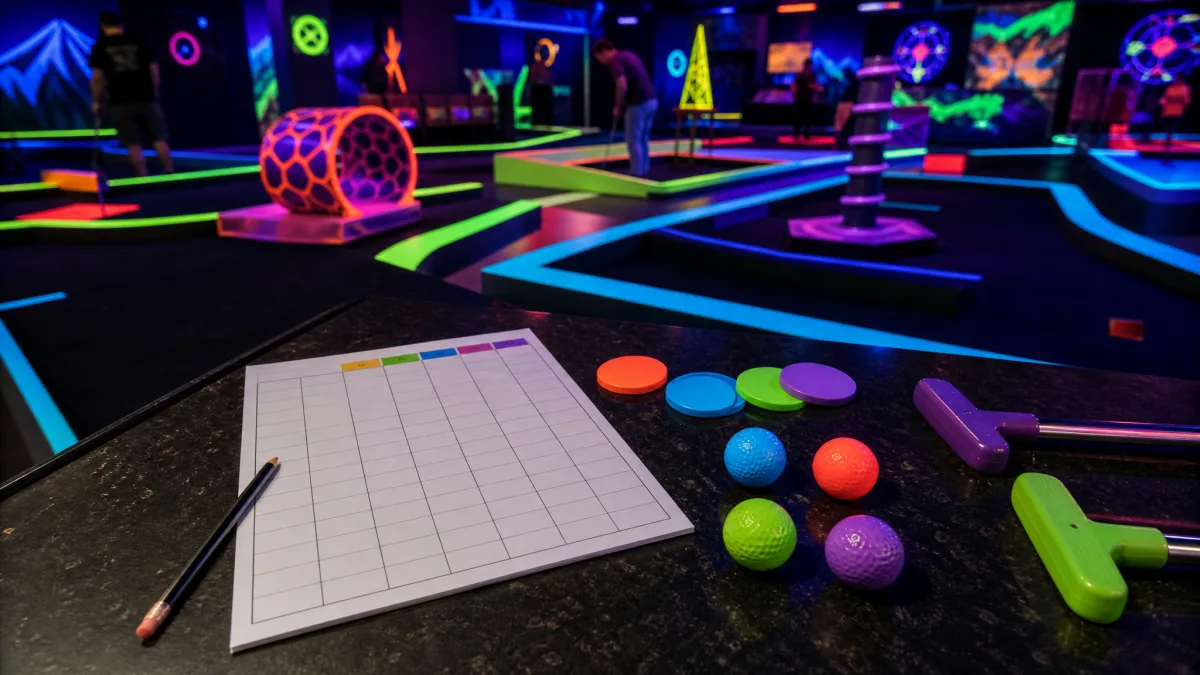
For a casual event, skip strict scoring and use awards instead. Good awards include best helper, best bank shot, closest first putt, best team name, and best comeback. The mini golf awards guide has more prize categories, and the mini golf scorecard guide explains simple scorekeeping.
If players are new to the game, send the mini golf rules and scoring guide before the event or link it in the invitation.
When to rent instead of build
Build your own holes when the event is small, informal, or mostly about creativity. Rent portable mini golf when the event needs a cleaner look, faster setup, more durable holes, or predictable equipment.
Renting usually makes more sense for:
- Company picnics.
- School field days.
- Weddings.
- Fundraisers.
- Large birthday parties.
- Community events.
- Indoor events where floor protection matters.
- Groups that need putters and balls included.
Many portable mini golf rental companies offer 3, 6, or 9-hole setups, and rental examples may list space such as 10 by 20 feet for 3 holes or 20 by 30 feet for 9 holes. Treat those numbers as examples, not universal rules. Ask the rental company for the exact footprint, surface rules, delivery window, equipment list, supervision needs, and weather policy.
If you want a venue instead of a rental, compare indoor mini golf, outdoor mini golf, mini golf for kids, and adult mini golf venues.
Mini golf hole ideas FAQ
What are good mini golf hole ideas?
Good mini golf hole ideas include a straight gate, box tunnel, pool noodle curve, small ramp, bridge shot, slalom path, target circle, split path, and mystery-wall bank shot. Start with one challenge per hole so players know where to aim.
How many mini golf holes should I make for a party?
For most backyard, office, classroom, or party setups, make 3 to 6 holes. That is enough for a 30 to 60 minute activity when guests replay holes, rotate teams, or add small challenges. Use 9 holes for larger events, fundraisers, or longer group sessions.
What materials work for DIY mini golf holes?
Useful DIY mini golf materials include cups, painter tape, cardboard boxes, pool noodles, cones, PVC pipe, plywood, turf mats, bricks, buckets, toy blocks, and lightweight signs. Choose materials that are easy to see, easy to move, and safe if a ball hits them.
How much space does a temporary mini golf hole need?
A simple temporary mini golf hole can fit in a lane about 6 to 12 feet long and 2 to 3 feet wide. Leave extra space for players to stand, write scores, and walk around the hole without stepping into another lane.
What are good office mini golf hole ideas?
Good office mini golf hole ideas include a conference-room tunnel, desk-leg bank shot, copy-room straight shot, hallway slalom, break-room target circle, and team-branded sponsor hole. Avoid blocked exits, glass, loose cords, and tape that can damage floors.
What mini golf hole ideas work best for kids?
Kids usually do best with visible goals, wide lanes, simple tunnels, gentle ramps, color targets, pool noodle bumpers, short putting distances, and a 5 or 6 stroke limit. Use target circles instead of tiny holes for very young players.
How do you make a mini golf hole harder?
Make a mini golf hole harder by narrowing the gate, adding a bank shot, using a split path, moving the target farther away, adding a gentle ramp, or setting a par challenge. Avoid making it harder by forcing players to hit harder.
Are DIY mini golf holes safe indoors?
DIY mini golf holes can be safe indoors if you use lightweight obstacles, avoid loose cords, keep balls away from stairs and glass, protect floors, and leave clear walking paths. Test every hole before guests play.
Mini Golf Spots
Find Mini Golf Courses Near You
Browse local courses, compare ratings, and find the right place for your next round.