No single person invented mini golf. The history of mini golf developed in stages: a ladies putting club at St Andrews in 1867, private miniature courses in the United States, new artificial playing surfaces, the themed Tom Thumb Golf boom of the 1920s, and Putt-Putt's standardized skill game in the 1950s.
Garnet Carter is often called the inventor of mini golf, but that answer is too simple. Carter and his wife, Frieda, helped shape the playful American version with fairy-tale obstacles and a commercial system that spread nationwide. They built on forms of small-scale putting that already existed.
Mini golf history timeline
| Year | Development | Why it matters |
|---|---|---|
| 1867 | St Andrews Ladies Golf Club forms | An early organized putting course becomes part of golf history |
| Around 1916 | Thistle Dhu is built in Pinehurst | A private American course shrinks golf strategy into a garden layout |
| 1922 | Thomas McCulloch Fairbairn develops an artificial putting surface | Durable greens make courses practical in more places |
| 1926 | Tom Thumb Golf appears at Lookout Mountain | Fairy-tale scenery and obstacles turn putting into an attraction |
| 1930 | Garnet Carter files a miniature-golf course-unit design patent | Themed miniature golf becomes a repeatable commercial product |
| 1930 | The American mini golf craze peaks | Thousands of courses open in cities, resorts, and roadside locations |
| 1931 | East Potomac Park Mini Golf opens in Washington, DC | The course becomes a rare surviving link to the first boom |
| 1954 | Putt-Putt begins in Fayetteville | Standardized, skill-based miniature golf gains a national brand |
| Late twentieth century | Adventure, glow, and entertainment-center courses expand | Mini golf becomes a broad family, tourist, date, and group activity |
| Today | Traditional and technology-driven formats coexist | Players can choose classic courses, competitive minigolf, glow golf, and automatic scoring |
Who invented mini golf? The evidence
The question "Who invented mini golf?" depends on which version of the game you mean.
- The earliest organized miniature putting course has one origin story.
- The first well-documented American garden course has another.
- Artificial surfaces made commercial courses easier to build.
- The Carters popularized themed obstacles and national distribution.
- Putt-Putt later standardized a distinct branded game.
That is why reliable histories describe mini golf as an evolution. Calling Garnet Carter the sole inventor erases earlier courses. Calling the 1867 putting green the complete beginning ignores the obstacles, manufactured layouts, and commercial attractions that made modern miniature golf recognizable.
For a simple explanation of how today's game works, see what mini golf is. The Putt-Putt vs mini golf guide explains why one historic brand name became a common term for the wider activity.
The 1867 St Andrews starting point
The St Andrews Ladies' Putting Club traces its founding to 1867, when it was called the St Andrews Ladies Golf Club. Its undulating putting green became known as the Himalayas. Guinness World Records recognizes it as the oldest miniature golf course.
This course matters because it shows organized small-scale putting long before America's commercial miniature golf craze. Women had limited access to the full links, so a separate putting club offered a practical way to play. The green used natural contours rather than windmills, castles, or mechanical hazards.
It is reasonable to call the Himalayas an early ancestor of mini golf. It is less accurate to say that every modern miniature golf course descends from one deliberate invention there. The course belonged to putting culture, while later American builders turned reduced-scale golf into a separate amusement business.
Thistle Dhu brought miniature golf to an American garden
Around 1916, shipping magnate James Barber commissioned an 18-hole miniature course at his Pinehurst, North Carolina, estate. The course was called Thistle Dhu, a joke that sounds like "this'll do."
The National Park Service history of miniature golf describes Thistle Dhu as a garden course with short holes, hard-packed playing surfaces, borders, curves, and strategic hazards. It tried to reproduce the decisions of full-size golf within a compact setting.
Thistle Dhu was not yet the classic roadside course. It had no neon, arcade, or automatic scoring, and it was private rather than a mass-market attraction. Its importance is the design idea: a complete miniature course could stand on its own instead of serving only as a practice green.
Modern builders still use the same principle. A small course becomes interesting when each hole asks a clear question about angle, speed, slope, or route. The mini golf course design guide and mini golf hole ideas show how those decisions appear in current layouts.
Artificial surfaces made mini golf easier to build
Natural grass limited early putting courses. It needed land, irrigation, cutting, and constant care. A small commercial course could not spread widely until builders had a durable, consistent surface.
In the early 1920s, Thomas McCulloch Fairbairn developed a putting surface made with cottonseed hulls, sand, oil, and dye. The material could be installed in places where maintaining natural turf was difficult. That helped miniature golf move into rooftops, empty lots, resorts, and dense cities.
The change was practical, not merely cosmetic. A predictable surface made banks and curves repeatable. Operators could build smaller holes, control ball speed, and reproduce a course design in more than one location.
Today's materials are different, but the same tradeoff remains. Artificial turf, felt, concrete, and other surfaces change speed, bounce, drainage, and maintenance. Those differences also help explain why competitive minigolf and a landscaped tourist course can feel like separate games.
Garnet and Frieda Carter made mini golf theatrical
The most famous chapter began at Lookout Mountain on the Tennessee-Georgia border. Garnet and Frieda Carter were developing a resort community called Fairyland. While a full golf course was delayed, they created a smaller attraction that became Tom Thumb Golf.
The exact division of credit varies by source. The National Park Service history emphasizes Frieda's creative role in the fairy-tale layout, while Rock City's account of the Carters describes Garnet's commercial development and the couple's shared Fairyland setting.
What made Tom Thumb different was its personality. Small buildings, gnomes, pipes, logs, curves, and themed hazards turned putting into a visual attraction for adults and children. The course did not merely copy golf at a smaller scale. It gave visitors something to explore and remember.
Garnet Carter distributed the concept as the 1920s ended, and he filed a miniature-golf course-unit design patent in November 1930. Course packages and manufactured parts helped operators reproduce the attraction elsewhere. This is the strongest reason Carter is often called the inventor of mini golf: he did not create the first small putting course, but he helped define and sell the whimsical commercial version.
The 1930 mini golf boom spread across America
Mini golf grew at extraordinary speed. A Smithsonian account of the Tom Thumb craze cites a 1930 Commerce Department estimate of 25,000 courses in the United States, with more than half built since the start of that year.
Courses appeared on rooftops, in vacant lots, beside hotels, and near theaters. They needed less land and equipment than full golf, and a round could fit into an urban evening. The game became part sport, part social outing, and part spectacle.
The boom also produced oversupply. Too many courses opened too quickly, quality varied, and the Great Depression reduced discretionary spending. Much of the first craze disappeared within a few years.
Not everything was lost. The boom established the basic business model: a compact course, an admission price, a memorable theme, and a round short enough for casual play. Those ideas still shape mini golf reservations, tourist attractions, birthday packages, and date-night venues.
Windmills came after the earliest courses
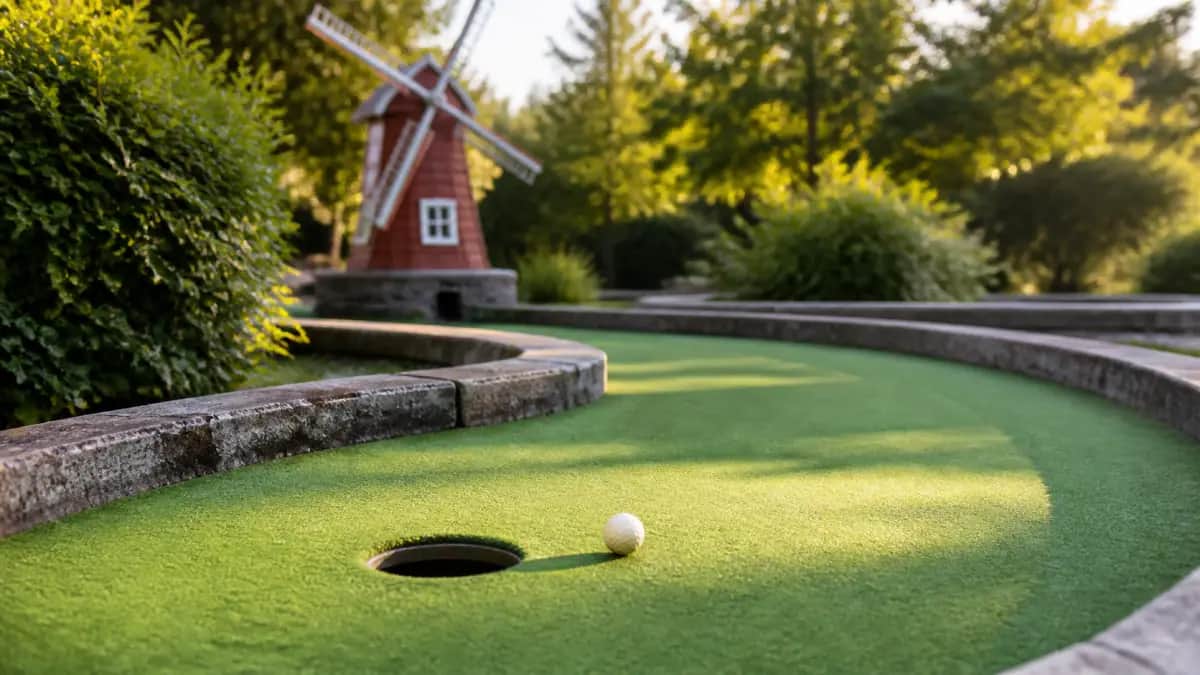
The windmill is now a symbol of mini golf, but it was not part of the 1867 Himalayas or the basic idea behind Thistle Dhu. It belongs to the later shift toward fantasy obstacles.
Course builders learned that a memorable object could do several jobs at once. It could create a tunnel or timing challenge, make the venue visible from the road, give families a photo spot, and distinguish one course from the next. Windmills, castles, lighthouses, animals, and moving parts became a design language for miniature golf.
There is no single proven moment when one windmill created the tradition. The better explanation is gradual adoption. Themed Tom Thumb courses established demand for scenery, and later manufacturers supplied increasingly elaborate obstacles during mini golf's postwar return.
Current courses do not need literal windmills to use the same approach. Glow rooms, local landmarks, pirate ships, projected effects, and automatic scoring all make the game more than a sequence of putts. The mini golf course ideas guide covers how themes and obstacles affect play today.
Putt-Putt made the game consistent and competitive
Don Clayton founded Putt-Putt in Fayetteville, North Carolina, in 1954. Instead of emphasizing fantasy props, the brand built standardized holes around skill, predictable banks, and consistent ball movement.
According to the brand's official Putt-Putt history, early courses used outdoor carpet, aluminum borders, and standardized construction. The company also helped develop organized competition through the Professional Putters Association.
Putt-Putt's influence explains two things that still confuse players. First, the name became so familiar that many people use "putt putt" for any miniature golf course. Second, mini golf can be both a casual amusement and a serious precision game.
If competitive play interests you, start with the professional mini golf guide, mini golf league guide, tournament planning guide, and rules and scoring guide. The equipment may look simple, but controlled speed and repeatable bank shots reward practice.
Mini golf expanded into several modern formats
The late twentieth and early twenty-first centuries did not replace classic mini golf. They added more versions.
| Modern format | Historical idea it keeps | What changes |
|---|---|---|
| Classic outdoor course | Landscaped garden putting and themed obstacles | Durable turf, water features, larger scenery |
| Adventure golf | Tom Thumb's theatrical setting | Immersive stories, caves, ships, waterfalls, local themes |
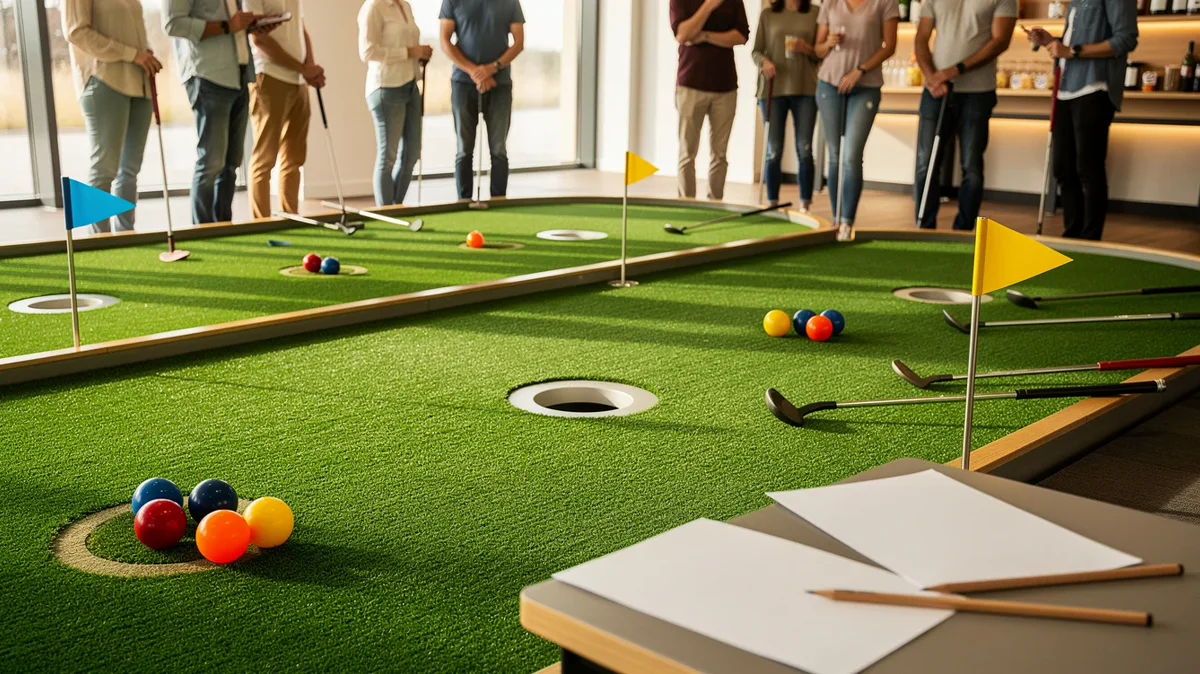
| Glow mini golf | Compact indoor commercial courses | Blacklights, fluorescent art, music, weather protection |
| Competitive minigolf | Putt-Putt's emphasis on repeatable skill | Standardized surfaces, formal equipment, tournament rules |
| Tech-enabled social golf | Mini golf as a group attraction | Automatic scoring, screens, bonus points, food and drinks |
| Portable mini golf | Prefabricated course systems | Temporary event layouts that can move between venues |
This variety is why recent course photos matter. An indoor glow venue and a quiet outdoor garden course share the same basic goal, but the noise, pace, scenery, age rules, and scoring can be completely different.
Use the course directory to compare local options, or browse mini golf by location. The best mini golf pages are useful when you want a ranked shortlist, while the indoor mini golf guide and outdoor mini golf guide separate the two broadest course styles.
What mini golf history explains about the game today
The game's history explains why mini golf has no single standard experience.
- St Andrews represents accessible, social putting on a compact green.
- Thistle Dhu represents golf strategy reduced to garden scale.
- Artificial surfaces made commercial expansion practical.
- Tom Thumb Golf made scenery and obstacles central to the attraction.
- Putt-Putt made repeatable skill and standardization central to a brand.
- Modern venues combine those ideas with lighting, food, technology, and group events.
The common thread is not the windmill. It is the ability to turn putting into an activity that fits a smaller space and welcomes people who may never play full golf.
History of mini golf FAQ
Who invented mini golf?
No single person invented every form of mini golf. The game developed through the 1867 St Andrews Ladies Putting Club, early American miniature courses, artificial putting surfaces, and Garnet and Frieda Carter's themed Tom Thumb Golf.
When was mini golf invented?
Mini golf has roots in nineteenth-century putting. The St Andrews Ladies Golf Club began in 1867, Thistle Dhu appeared around 1916, and commercial themed miniature golf expanded rapidly in the late 1920s.
What was the first mini golf course?
The Himalayas at St Andrews, founded with the ladies putting club in 1867, is commonly treated as the earliest documented miniature putting course. Thistle Dhu, built around 1916, is an early American predecessor of modern mini golf.
Was mini golf invented for women?
Women were central to one important early chapter. The St Andrews Ladies Golf Club formed in 1867 and played on a putting course when access to full golf was restricted, but modern commercial mini golf later developed through several American innovations.
What was Thistle Dhu?
Thistle Dhu was an 18-hole private miniature course built for James Barber in Pinehurst, North Carolina, around 1916. Its short garden holes used borders, curves, and hazards to reproduce golf strategy in a smaller space.
What did Garnet Carter contribute to mini golf?
Garnet Carter helped turn miniature golf into a themed commercial attraction. Tom Thumb Golf used fairy-tale scenery and playful hazards, then spread through manufactured course plans, commercial distribution, and a 1930 course-unit design patent.
Why do mini golf courses have windmills?
Windmills became a visual shorthand for miniature golf as course builders added playful buildings, moving parts, tunnels, and fantasy obstacles. They were not part of the earliest putting courses.
When did Putt-Putt begin?
Putt-Putt began in Fayetteville, North Carolina, in 1954. It emphasized standardized, skill-based holes with consistent carpet, aluminum borders, and predictable rebounds.
Did the Great Depression end mini golf?
The Great Depression ended much of the first commercial boom, but it did not end the game. Mini golf returned through inexpensive homemade courses, postwar roadside attractions, themed obstacles, and standardized Putt-Putt courses.
Is mini golf still played as a competitive sport?
Yes. Mini golf is both a casual attraction and a competitive sport, with local leagues, national associations, international championships, standardized surfaces, and formal stroke-play and match-play events.
Mini Golf Spots
Find Mini Golf Courses Near You
Browse local courses, compare ratings, and find the right place for your next round.