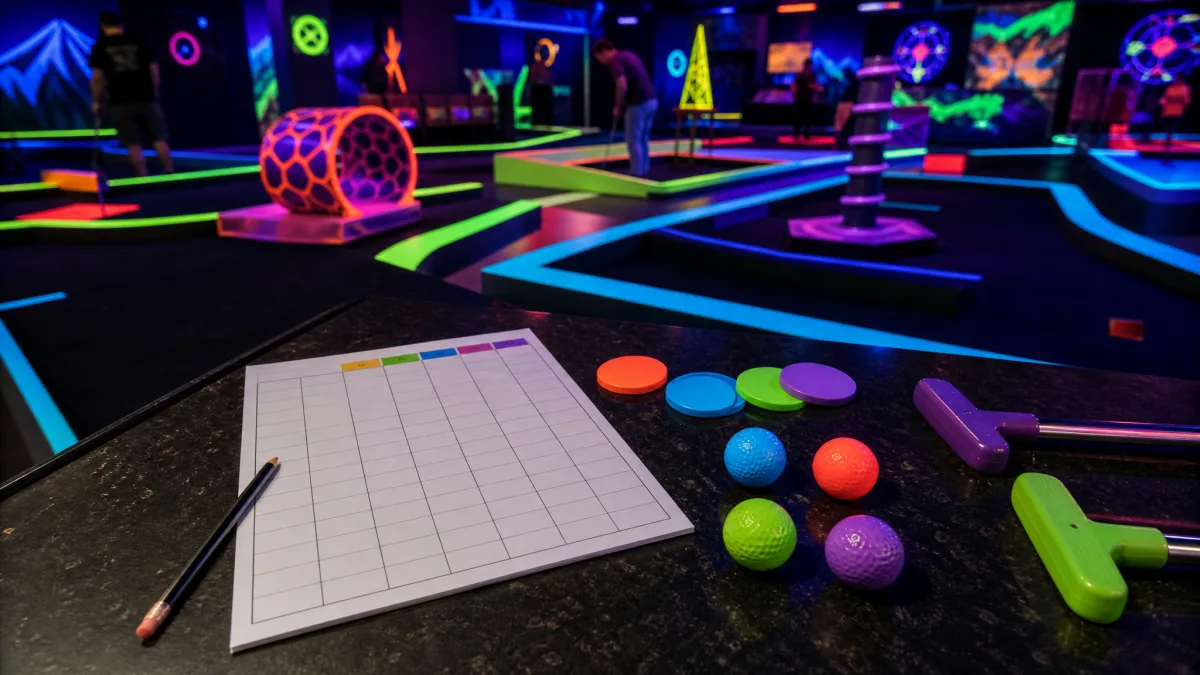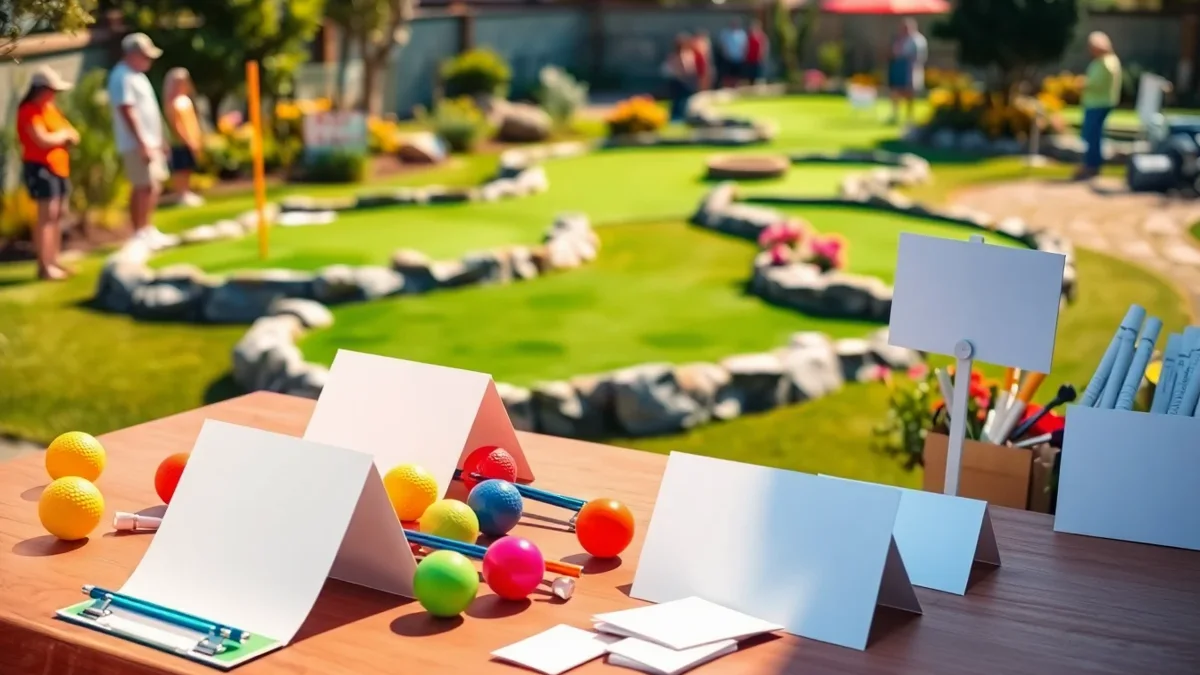

Mini golf tournament ideas work best when the format is easy to explain, the rules fit casual players, and the course can keep everyone moving. For most family, work, birthday, fundraiser, or friend-group tournaments, choose one simple format, use teams of two to four, set a 5 or 6 stroke limit, and decide prizes before the first putt.
This guide focuses on tournament setup rather than game variations. If you want extra challenges for a normal round, start with mini golf games and challenges. If the same teams will play over several weeks, use the mini golf league guide instead. If you want sanctioned tours, rankings, and professional divisions, read the professional mini golf guide. If the tournament is raising money, pair this with the mini golf fundraiser guide before setting ticket prices.
Quick answer: mini golf tournament ideas that work
The best mini golf tournament setup for most groups is team best ball with a 5 or 6 stroke maximum per hole, one scorekeeper per group, and prizes for both score and fun categories. It works for beginners because a bad hole does not ruin the team, and it works for competitive players because every hole still has a clear score.
Use this quick match:
| Group | Best format | Team size | Start style | Prize idea |
|---|---|---|---|---|
| Family party | Team best ball | 2 to 4 | Normal start | Winner, best team name, best comeback |
| Work outing | Team average | 3 to 4 | Staggered starts | Lowest team, best department name |
| Fundraiser | Team best ball | 2 to 4 | Venue-approved start | Trophy, sponsor prize, closest first putt |
| Kids birthday | No-score awards | 2 to 3 with an adult helper | Normal start | Stickers, medals, arcade credit |
| Competitive friends | Stroke play | 1 or 2 | Normal start | Champion, playoff winner |
| Large group | Shotgun or staggered starts | 2 to 4 | Ask the venue | Team prize and funny awards |
How to organize a mini golf tournament
Organize a mini golf tournament by deciding the group size, choosing a course, picking one scoring format, writing a short rule sheet, assigning scorekeepers, setting prizes, and confirming start timing with the venue.
- Set the goal: Decide whether the event is a family party, work outing, fundraiser, birthday, league night, or competitive friend bracket.
- Choose the venue: Use the mini golf course directory to build a shortlist, then check capacity, group pricing, food, weather rules, accessibility, and whether the venue supports tournament starts.
- Pick one format: Team best ball is the easiest default. Use stroke play for competitive groups, no-score awards for young kids, and team average for work groups.
- Write the rules: Confirm the stroke limit, out-of-bounds rule, tie breaker, scorekeeper role, and whether house rules override your event rules.
- Make the scorecard: Include team names, player names, hole numbers, start hole or tee time, stroke limit, tie breaker, and prize categories.
- Plan prizes and awards: Use one or two score prizes, then add social awards such as best team name, best comeback, or closest first putt.
- Send arrival notes: Tell players when to arrive, where to check in, what format you are using, how long the round should take, and where awards happen.
Choose a mini golf tournament format
Pick the format before you invite players. The format affects team size, timing, scorecards, prizes, and whether beginners feel comfortable.
Team best ball
Team best ball is the safest default for casual mini golf tournaments. Everyone plays their own ball on each hole, then the team records the lowest score from its players.
Example: if a team of two scores 2 and 5 on a hole, the team records 2.
Use team best ball when:
- Players have different skill levels.
- Families, coworkers, or sponsors are mixed together.
- You want a real winner without punishing beginners.
- The group has enough time for every player to finish each hole.
For larger events, keep teams to two or four players. Odd team sizes can work, but they make scorecards and prizes harder.
Team average
Team average uses every player's score. Add the team scores on a hole, divide by the number of players, and use that average as the team score.
This is useful for work outings because everyone contributes, but it takes more math. If you use team average, assign one careful scorekeeper and round consistently. Rounding to one decimal place is enough.
Scramble
In a scramble, everyone putts from the tee area, the team chooses the best ball position, and every teammate plays the next shot from that spot. Repeat until the ball is holed.
Scramble is friendly for beginners and can move quickly when the course is open. It can also be awkward on tight mini golf holes, because multiple people may need to place balls near the same obstacle. Ask the venue before using it for a large group.
Stroke play
Stroke play is normal scoring: every player records every stroke, and the lowest total wins. It is the cleanest format for competitive friends, leagues, and adults who want a real leaderboard.
Use stroke play only when players understand the rules and can keep pace. For mixed groups, add a 5 or 6 stroke maximum so one hard hole does not trap the group.
Match play bracket
Match play makes each hole a small contest. The player or team with the lower score wins that hole. The player or team with the most holes won advances or wins the match.
Match play is good for small brackets because a single bad hole only costs one point. It is less useful for large groups unless you have enough time for semifinals, finals, and a clear bracket.
No-score awards
No-score awards are best for young kids, birthday parties, casual family reunions, and groups that care more about photos than leaderboards.
Use awards such as:
- Best team name.
- Best bank shot.
- Best recovery.
- Best helper.
- Most patient player.
- Closest first putt.
- Best celebration.
This still feels like a tournament, but nobody has to defend a scorecard.
Write mini golf tournament rules before play starts
Good mini golf tournament rules are short. Put them on one page or one phone note and give every scorekeeper the same version.
Use this basic rule sheet:
| Rule | Practical default |
|---|---|
| Stroke limit | 5 or 6 strokes per hole |
| Turn order | Everyone takes a first putt, then continue by closest or house rule |
| Ball off course | Replace near the exit point and add one stroke |
| Ball against wall | Move one putter-head length away if the venue allows it |
| Equipment | Use venue balls and putters unless the course says otherwise |
| Scorekeeping | One scorekeeper per group, scores written after clearing the hole |
| House rules | Venue rules beat group rules |
| Ties | Use the tie breaker chosen before play starts |
If your players are new, send them the mini golf rules and scoring guide before the event. For scorecard basics, use the mini golf scorecard guide.
Pick the right start style
Start style matters more as the group gets larger. A normal family round can simply start at hole 1. A larger tournament may need staggered starts, timed groups, or a venue-approved shotgun start.
Normal start
Use a normal start for small groups. Everyone begins at hole 1 in order, and the next group waits until the first group clears.
Best for:
- 2 to 12 players.
- Family events.
- Birthday groups with kids.
- Casual friends.
- Any venue that does not offer private tournament starts.
Staggered tee times
Staggered starts send groups out every 5 to 10 minutes, depending on the course and venue rule. This is useful when people are arriving over a window instead of all at once.
Best for:
- Work groups.
- Open-house style fundraisers.
- Parties with flexible arrivals.
- Venues that need to keep normal guests flowing.
Shotgun start
A shotgun start places groups on different holes and starts them at the same time. On an 18-hole course, one group might start on hole 1, another on hole 4, another on hole 9, and so on. Each group loops around until it has completed all assigned holes.
Use a shotgun start only when the venue approves it. The course needs staff direction, clear routing, and enough open holes. It can be great for large private events because everyone starts and finishes closer together, but it can be confusing at a public course that is still taking walk-ins.
Build a simple scorecard
A mini golf tournament scorecard should be easy to read while people are standing near the course.
Include:
- Event name.
- Date and venue.
- Team name.
- Player names.
- Start hole or tee time.
- Hole numbers.
- Stroke limit.
- Tie breaker.
- Prize categories.
- Scorekeeper name.
For team best ball, add columns for each player and a team-score column. For no-score awards, use checkboxes instead of full scoring.
For a simple mini golf tournament scorecard template, copy the fields above into a one-page sheet and leave enough space for 9 or 18 holes. Print one rule sheet for each scorekeeper, or send the same note by text before the round so nobody is using a different tie breaker.
If the tournament uses team names, keep them short enough for scorecards and photos. The mini golf team names guide has clean names for work outings, fundraisers, kids, glow golf, and brackets.
Decide tie breakers before the first hole
Ties are easy if the rule is written down before the round. They become awkward when players find out after scores are collected.
Use one of these tie breakers:
| Tie breaker | Best for | How it works |
|---|---|---|
| Playoff hole | Competitive adults | Tied players replay one selected hole |
| Final-hole score | Casual tournaments | Lower score on the last hole wins |
| Reverse card-off | Work and league events | Compare hole 18, then 17, then 16 until one team is lower |
| Closest first putt | Parties | One putt on a selected hole, closest ball wins |
| Fewest stroke-limit holes | Beginner groups | Player with fewer max-score holes wins |
| Shared award | Kids and family events | Tie stays tied, prize is split or duplicated |
For fundraisers and company outings, shared awards are often better than long playoffs. For competitive friends, a playoff hole is more satisfying.
Add prizes without making the event too serious
Mini golf tournament prizes should be small enough to keep the mood friendly. A trophy or medal is fun, but the best events usually mix score prizes with social awards.
Good score prizes:
- Lowest individual score.
- Lowest team score.
- Best team best-ball score.
- Playoff winner.
- Closest first putt.
- Most holes won.
Good fun awards:
- Best team name.
- Best bank shot.
- Best comeback.
- Best outfit.
- Best obstacle read.
- Best celebration.
- Most helpful teammate.
- Best photo moment.
For sponsored events, match prizes to the event. A local restaurant gift card, arcade credit, dessert voucher, donated family pass, or small trophy usually fits better than a high-stakes cash prize.
Avoid prizes that embarrass the lowest scorer unless the group is adult-only and everyone knows the joke will land well.
For a larger category list, use the mini golf awards and prizes guide before you print scorecards or set up a prize table.
Ask the venue these tournament questions
Before you promise a tournament format, confirm what the venue can support. A normal walk-in round is different from a tournament with teams, scorecards, signs, food, prizes, and start timing.
Ask:
- How many players can start in one hour?
- What group size do you recommend per hole?
- Can we reserve a time block?
- Do you allow staggered starts or shotgun starts?
- Can teams start on different holes?
- Are scorecards, pencils, balls, and putters included?
- Can we use our own scorecards or signs?
- Is there a party room, table, or award space?
- Are food, drinks, decorations, or sponsor signs allowed?
- What is the weather policy for outdoor courses?
- Are there age limits, chaperone rules, or alcohol rules?
- Is the course accessible for guests using mobility aids?
- What happens if fewer players attend than expected?
- Does the venue need final headcount by a deadline?
If accessibility, crowding, lighting, or noise could affect your group, review the mini golf accessibility guide and mini golf etiquette guide before booking.
Use a sample format for your group
You do not need to invent everything from scratch. Start with one of these formats and adjust only what the venue requires.
| Event | Format | Rules | Prizes |
|---|---|---|---|
| 8-player family tournament | 2-person team best ball | 6 stroke max, normal start | Winning team, best team name |
| 16-player work outing | 4-person team average | 5 stroke max, staggered starts | Lowest team, best department name, best comeback |
| Kids birthday tournament | No-score awards | Short round, adult helpers, loose stroke limit | Medals, stickers, best celebration |
| Fundraiser tournament | 4-person team best ball | 6 stroke max, sponsor holes, scorekeeper per group | Trophy, closest first putt, sponsor prize |
| Competitive friend bracket | Match play | 6 stroke max, playoff hole for final | Champion, runner-up, best bank shot |
If timing is tight, check how long mini golf takes before choosing an 18-hole format. A small group may finish quickly, but check-in, photos, food, and awards can add real time.
Where to host a mini golf tournament
The right course depends on the group. Outdoor courses work well for classic bank shots, family photos, and summer fundraisers. Indoor courses are better for weather-sensitive plans, school groups, winter events, and tight schedules. Adult mini golf venues can work for work teams, date-night groups, and friend tournaments, but check age and drink rules before booking.
Start with the mini golf course directory, browse mini golf by location, or compare best mini golf courses if you are planning in a larger market. For specific needs, compare indoor mini golf, outdoor mini golf, kid-friendly mini golf, or adult mini golf venues.
Before you book, look at photos, recent reviews, course layout, parking, food options, hours, and group rules. A good tournament venue is not always the flashiest course. It is the course that can move your group smoothly, explain house rules clearly, and give players enough room to enjoy the round.
Mini golf tournament FAQ
How do you organize a mini golf tournament?
Organize a mini golf tournament by choosing a venue, setting the format, making teams, writing a short rule sheet, assigning scorekeepers, picking prizes, and confirming start timing with the course. Keep the format simple enough for a first-time player to understand before the first hole.
What is the best mini golf tournament format?
Team best ball is usually the best mini golf tournament format for mixed-skill groups because every player can finish each hole, but the team records only its lowest score. Stroke play is better for competitive players, and no-score awards are better for young kids.
How many people should be on a mini golf team?
Two to four people per mini golf team is easiest for scoring and pace. Larger events should split guests into smaller teams or groups so one hole does not get backed up.
What rules should a mini golf tournament use?
Use clear rules for stroke limits, ball relief, out-of-bounds shots, scorekeeping, ties, and house rules. A 5 or 6 stroke maximum per hole keeps most casual tournaments moving.
How long does a mini golf tournament take?
A small 18-hole mini golf tournament often takes 60 to 90 minutes of play, plus check-in and awards. Larger groups should ask the venue about capacity and start timing before sending guests a schedule.
What are good mini golf tournament prizes?
Good mini golf tournament prizes include small trophies, medals, arcade credit, snack vouchers, sponsor prizes, team-name awards, closest-first-putt prizes, and funny awards. Keep prizes friendly unless the group specifically wants a competitive event.
How do you handle ties in a mini golf tournament?
Handle ties with a playoff hole, lowest score on the final hole, reverse scorecard comparison, closest first putt, shared awards, or a prize split agreed before play starts. Write the tie rule on the scorecard or rule sheet.
Should a mini golf tournament use a shotgun start?
Use a shotgun start only when the venue approves it and can place groups on different starting holes. Small groups usually work better with normal or staggered starts.
Mini Golf Spots
Find Mini Golf Courses Near You
Browse local courses, compare ratings, and find the right place for your next round.