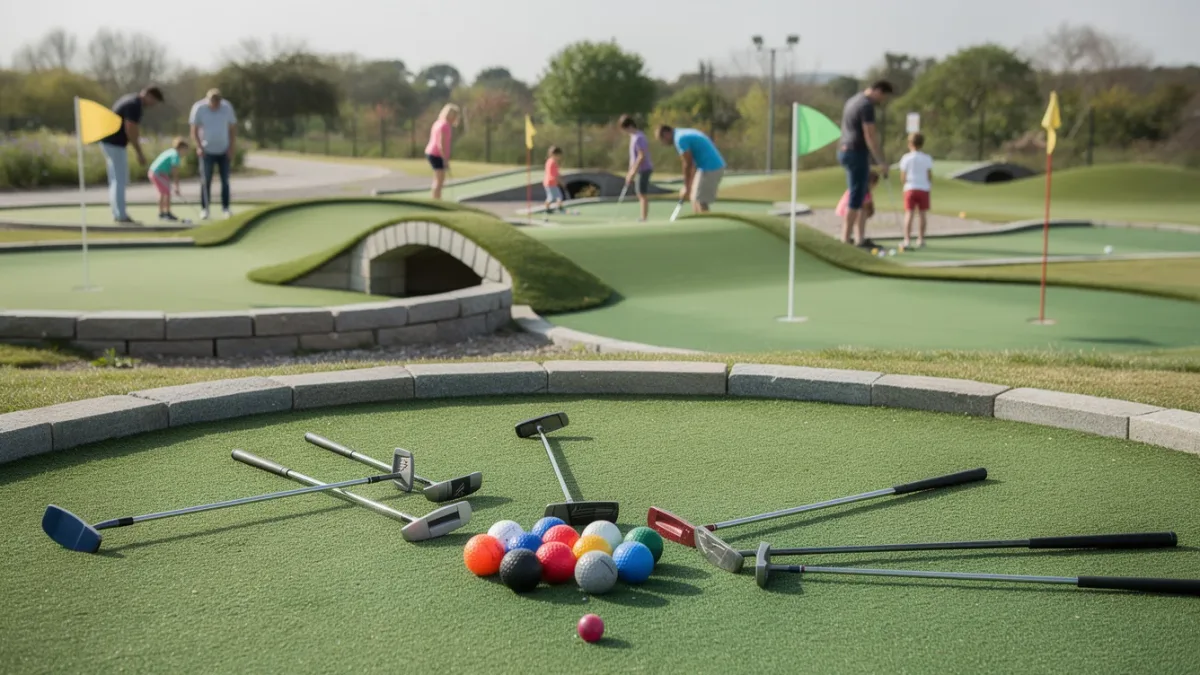

A mini golf league is a recurring way to play with the same group over several weeks. Instead of one casual round, players join teams, play scheduled matches, track standings, and usually finish with prizes, playoffs, or a championship night.
For most venues and friend groups, the easiest mini golf league format is two-player teams, one weekly round, best-ball scoring, a 5 or 6 stroke limit, and a final playoff. If you only need a one-day event, use the mini golf tournament ideas guide instead. If you want casual variations inside a normal round, start with mini golf games and challenges.
Quick answer: how a mini golf league works
A mini golf league usually runs for 5 to 10 weeks. Teams play one scheduled round per week, record scores or match points, move up or down the standings, and end the season with a playoff or awards night. Two-player teams are common because they are easy to schedule, easy to score, and still social.
Use this default setup if you are starting from scratch:
| League decision | Simple default |
|---|---|
| Season length | 6 weeks |
| Team size | 2 players, with 1 optional substitute |
| Weekly round | 9 or 18 holes |
| Format | Team best ball |
| Stroke limit | 6 strokes per hole |
| Standings | Win-loss record, then total score differential |
| Tie breaker | Playoff hole or final-hole score |
| Prizes | Champion, runner-up, best team name, most improved |
What makes league play different
League play sits between a casual round and a tournament. A normal round is one outing. A tournament is usually one event. A mini golf league gives people a reason to come back every week, learn the course, meet other teams, and care about standings without making the night feel too serious.
Organized competition is not new. Putt-Putt helped turn standardized putting into a recurring competitive game in the 1950s, one chapter in the wider history of mini golf.
If you want sanctioned tours, association memberships, rankings, and cash-purse events rather than a local social season, use the professional mini golf guide.
The recurring format changes the planning:
- Teams need names, rosters, and substitute rules.
- The venue needs tee times, scorecards, and a consistent schedule.
- Players need to know what happens if someone misses a week.
- The scoring system needs to handle ties, weather, playoffs, and late arrivals.
- The league should be fun even for teams that are not near first place.
That last point matters. Mini golf leagues work best when a beginner team can still enjoy the season. Use small weekly prizes, social awards, and rotating formats so the standings are not the only reason to show up.
Choose the right mini golf league format
Pick one main format before registration opens. You can add theme nights or bonus prizes later, but the core format should be easy enough to explain in a short sign-up page.
Two-player best ball
Two-player best ball is the safest default for a mini golf league. Both players on the team play their own ball on each hole, then the team records the lower score.
Example: if one teammate scores 2 and the other scores 5, the team score for that hole is 2.
Use best ball when:
- Players have mixed skill levels.
- The league is social, not intensely competitive.
- Teams need a forgiving format.
- You want each player to putt every hole.
- The standings should be easy to read.
Best ball also works well for substitutes. If one regular player misses a week, the substitute can step in without changing the whole format.
Individual stroke play
Individual stroke play is normal mini golf scoring. Each player records every stroke, and the lowest total wins the weekly round or season.
This is clean for competitive players, but it can be unforgiving for beginners. If you use individual stroke play, add a stroke limit and consider weekly flights so new players are not competing directly against the same best player every week.
Match play
In match play, teams win holes instead of adding every stroke. The team with the lower score on a hole wins that hole, and the team with more holes won takes the match.
Match play is useful because one bad hole does not ruin the night. It also makes head-to-head matches feel more direct. If you want a bracket-style final week, match play can work well for playoffs.
Rotating weekly formats
Rotating formats make a social league more fun. One week can be best ball, another can be scramble, another can count only odd-numbered holes, and another can award bonus points for closest first putt.
Use rotating formats only if the commissioner can explain them clearly every week. If the rules feel different and confusing each night, players will trust the standings less.
Good rotating formats include:
- Team best ball.
- Scramble.
- Match play.
- Closest first putt.
- Mystery bonus holes.
- Team average.
- Stroke play with one throw-out hole.
For more casual options, use the mini golf games guide and choose one format per week.
Set mini golf league rules before sign-up
Mini golf league rules should be written before teams pay. They do not need to be complicated, but they need to answer the situations that cause arguments.
Use this rule checklist:
| Rule area | What to decide |
|---|---|
| Team size | Two-player teams, larger rosters, or individual players |
| Substitutes | Whether subs are allowed, how often, and whether playoff subs are allowed |
| Weekly schedule | Fixed night, tee-time window, shotgun start, or flexible play |
| Stroke limit | Usually 5, 6, or 7 strokes per hole |
| Ball relief | Whether players can move a ball from a wall, obstacle, or blocked line |
| Out of bounds | Where to replace the ball and whether to add a stroke |
| Equipment | Venue putters and balls, personal putters, or both |
| Scorecards | Who records scores, where cards are turned in, and penalties for missing cards |
| Late arrivals | Grace period, forfeit rule, or make-up option |
| Ties | Playoff hole, final-hole score, combined score, or shared points |
| Standings | Win-loss, total strokes, point differential, or weekly rank |
| Playoffs | Who qualifies, format, and whether regular-season standings matter |
House rules should always win. If the venue has posted rules for moving balls, stroke limits, alcohol, age limits, or course behavior, use those rules as the league baseline. The mini golf rules and scoring guide is useful for writing the casual version, and the mini golf etiquette guide helps keep league nights friendly.
Build the schedule around real people
The best mini golf league schedule is predictable. Pick the same night each week, give teams a clear check-in window, and publish the season dates before registration opens.
Most leagues should answer these questions:
- What night of the week is league night?
- What time does check-in start?
- Are teams assigned tee times?
- Can teams play any time within a window?
- What happens during rain, heat, or outdoor course closures?
- Can a team miss one week without being removed?
- Are make-up rounds allowed?
- When are playoffs?
- When are prizes awarded?
For a small private league, a fixed start time is fine. For a public venue league, tee times every 5 to 10 minutes can keep the course from backing up. If the venue has enough space and staff, a shotgun start can help everyone finish closer together, but it should only be used when the course approves it.
If timing is the main concern, check how long mini golf takes before you choose 9 holes, 18 holes, or a playoff night.
Handle teams, substitutes, and names
Two-player teams are easiest, but real schedules are messy. A league that does not allow any substitute players may lose teams after one missed week. A league that allows unlimited substitutes can feel unfair near playoffs.
Use one of these substitute rules:
| Substitute rule | Best for |
|---|---|
| No substitutes | Competitive small leagues |
| One named substitute | Casual leagues with stable teams |
| Up to four rostered players | Social leagues where attendance varies |
| Subs allowed in regular season only | Leagues with serious playoffs |
Require team names during registration. Names make standings easier to read and give casual teams something to enjoy even if they are not winning. For work groups, fundraisers, and public scoreboards, use clean names from the mini golf team names guide.
Score league rounds without confusion
The scoring system should match the league goal. A competitive league can use total strokes and playoff brackets. A social league may work better with weekly points and fun awards.
Common scoring options:
| Scoring option | How it works | Best for |
|---|---|---|
| Total strokes | Add the weekly team score | Competitive groups |
| Win-loss record | Head-to-head winner gets the match | Divisions and playoffs |
| Match points | Teams earn points for wins, ties, and weekly rank | Larger leagues |
| Score differential | Winning margin helps rank tied teams | Playoff seeding |
| Weekly rank | Teams are ranked first through last each week | Social leagues with changing formats |
| Throw-out week | Lowest weekly result is dropped | Leagues where teams may miss one night |
For best ball, the scorecard should show both team names, both player names, the best score for each hole, total score, and any playoff note. For individual stroke play, use the normal scorecard format from the mini golf scorecard guide.
Decide playoffs and prizes early
Playoffs give the season a finish, but they can also create scheduling problems. Keep the playoff format proportional to the league size.
Simple playoff options:
| League size | Playoff format |
|---|---|
| 4 to 6 teams | Top 2 final match |
| 8 to 12 teams | Top 4 bracket |
| 12 to 20 teams | Top 8 bracket or play-in round |
| Social league | Championship night plus fun awards |
Good league prizes include:
- Champion trophy.
- Engraved team name on a venue board.
- Gift cards.
- Free future round.
- League shirts or pins.
- Best team name.
- Most improved team.
- Most holes-in-one.
- Best sportsmanship.
- Weekly closest first putt.
Avoid making the entire prize structure depend on first place. Weekly prizes, best-name awards, and improvement awards keep teams engaged after a rough start.
Price the league clearly
Mini golf league pricing varies by venue, city, season length, prize pool, and food or drink inclusions. Some leagues charge per team for the full season. Some charge per player. Some collect a weekly fee. Some include every round, while others only cover registration and prizes.
Before registration opens, make the price page answer:
- Is the fee per player or per team?
- Does it cover every league round?
- Are playoff rounds included?
- Are putters, balls, scorecards, and staff included?
- Is tax or gratuity included?
- Are food, drinks, arcade credit, or discounts included?
- Is there a prize pool?
- Are refunds available if a team drops out?
- What happens if weather cancels a week?
For a private friend league, the simplest budget is the normal round price each week plus a small prize fund. For a venue-run public league, the fee should cover staff time, scorekeeping, prizes, card processing, and any included food or drink discounts.
If the price feels high, compare it to the total number of rounds. A season fee can look expensive at first, but may be reasonable when divided by player, week, and round.
How to join a mini golf league
Join a mini golf league by finding a venue or social sports league with open registration, choosing whether to enter as a full team or solo player, checking the schedule and rules, then registering before the season cap fills.
Most league sign-ups fit one of these paths:
| Sign-up path | Best for | What to check |
|---|---|---|
| Full team | Friends, couples, coworkers | Team size, roster limit, substitute rule |
| Solo player | New players without a teammate | Free-agent placement, waitlist, contact deadline |
| Workplace team | Company outings or alumni groups | Invoice options, team shirts, private start times |
| Returning team | Players from a prior season | Early registration, playoff eligibility, rule changes |
Before you pay, confirm the league night, start time, season length, included rounds, team size, substitute policy, playoff date, prizes, age rules, and refund policy. If you do not have a teammate, ask whether the venue pairs solo players or keeps a free-agent list.
How to start a mini golf league
Start with the venue, not the logo or trophy. A good league needs a course that can hold recurring tee times, accept groups, handle scorecards, and keep normal guests moving.
Use this organizer checklist:
- Choose one course and confirm league-night availability.
- Decide whether the league is venue-run, friend-run, work-run, or fundraiser-run.
- Pick team size, season length, weekly night, and main format.
- Write the rules before registration opens.
- Set the fee and what it includes.
- Create a simple sign-up form with team name, player names, email, phone, and substitute policy.
- Publish the full schedule, including playoff night.
- Prepare scorecards, standings, and weekly result updates.
- Assign one league manager or commissioner.
- Run week 1 as a rules and course-orientation night if many players are new.
If the league is for coworkers, pair this with the mini golf team building guide. If it is tied to a charity, school, or nonprofit, use the mini golf fundraiser guide before setting sponsor packages or donation goals.
How to find a mini golf league near you
Search for the course name plus league, miniature golf league, putt putt league, or mini golf league near me. Many leagues are posted on venue event pages, social channels, or email lists before they appear in broad search results.
Try this process:
- Search local venue websites for league, events, happenings, or tournaments.
- Check indoor mini golf bars and adult social venues first, since they often run weeknight leagues.
- Ask family entertainment centers whether they offer seasonal leagues, corporate nights, or private scorekeeping.
- Look at social sports league operators in your city.
- Call the course if the website only lists normal tee times.
Start with the mini golf course directory, browse mini golf by location, or compare adult mini golf venues if you want a weeknight social league with drinks. For weather-proof seasons, compare indoor mini golf.
Mini golf league FAQ
What is a mini golf league?
A mini golf league is a recurring season where players or teams play scheduled rounds, track scores or points, and usually finish with standings, prizes, or playoffs. It is more structured than a casual round but less intense than a formal golf league.
How do mini golf leagues work?
Most mini golf leagues use weekly rounds, two-player teams, a simple scoring format such as best ball or stroke play, standings, and a final playoff or awards night. The venue or league manager collects scorecards and updates results each week.
How many people are on a mini golf league team?
Two-player teams are the easiest format for most mini golf leagues. Some social leagues allow larger rosters so teams can rotate substitutes each week.
What is best ball in a mini golf league?
Best ball means both teammates play their own ball on each hole, then the team records the lower score from the two players for that hole. It is popular for casual leagues because one teammate can recover from the other's bad hole.
How long does a mini golf league season last?
Many mini golf league seasons run 5 to 10 weeks, often with regular-season rounds followed by a playoff, championship, or final tournament night. Shorter seasons are easier to fill, while longer seasons give standings more time to settle.
How much does a mini golf league cost?
Mini golf league cost varies by venue, season length, round count, prizes, and food or drink inclusions. Ask whether the fee is per player, per team, per week, or for the full season, and confirm whether playoff rounds are included.
Can beginners join a mini golf league?
Yes. Beginner-friendly mini golf leagues use casual rules, stroke limits, team formats, and social prizes so new players can contribute without needing serious golf skill. Two-player best ball is usually the easiest beginner format.
Can I join a mini golf league by myself?
Often, yes. Some venues and social sports leagues let solo players register as free agents, join a waitlist, or get paired with another player before the season starts. If the page only lists team registration, contact the venue before assuming you need a full team.
What rules should a mini golf league use?
A mini golf league should set rules for team size, scoring format, stroke limit, ball relief, out-of-bounds shots, scorecards, late arrivals, substitutes, ties, and playoffs. House rules from the venue should always override generic league rules.
Mini Golf Spots
Find Mini Golf Courses Near You
Browse local courses, compare ratings, and find the right place for your next round.